
SKINCARE SCIENCE & RESEARCH

Skincare is not static. Ingredients evolve, testing improves, and new claims appear faster than good evidence can keep up. This page is here to separate what is well-established from what is still emerging, so you can make decisions based on clarity rather than hype.
Some parts of skincare are backed by decades of consistent data (for example, sunscreen and retinoids). Other areas are promising but still early, with mixed results, small studies, or marketing that runs ahead of the science.
What “Evidence-Based” Actually Means
In skincare, strong evidence usually looks like:
-
Consistent results across multiple studies, not one standout paper
-
Realistic outcomes, measured over weeks to months, not overnight changes
-
Clear testing methods, including stability testing (e.g. does the formula stay active), and outcome measures that reflect real skin behaviour
-
Dose and tolerance reality, meaning the ingredient works at concentrations people can actually use long term
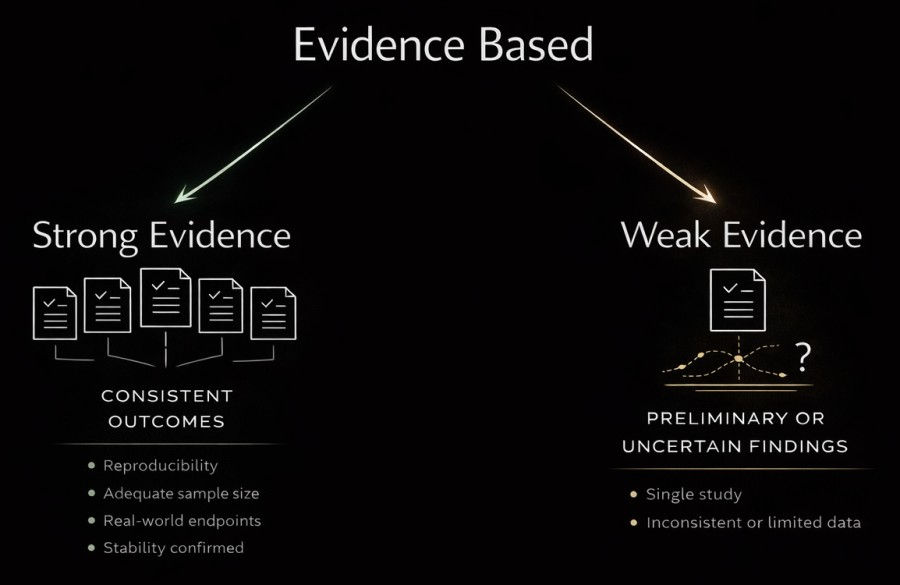
When evidence is weaker, you often see small sample sizes, short timelines, unclear endpoints, or claims that rely on theory rather than proven outcomes.
What We Know Works Reliably
These are the foundations that repeatedly show real-world benefit when used consistently:
-
Daily broad-spectrum sunscreen to reduce cumulative UV-driven damage and uneven skin tone
-
Retinoids (retinol and prescription options) for long-term improvements in texture, fine lines, and pigment regulation
-
Barrier-supportive moisturising to reduce irritation, improve comfort, and increase tolerance of active ingredients
-
Targeted actives (such as exfoliating acids, pigment regulators, antioxidants) when matched to the skin’s needs and introduced at a pace the skin can sustain
The pattern is consistent - the best outcomes come from simple structure, correct sequencing, and long-term adherence, not from stacking more products.
Where Research Is Moving Fast
1) The Skin Microbiome
The microbiome is a major research focus because it influences inflammation, sensitivity, and how skin responds to stress. The challenge is that microbiome science is complex, and “microbiome-friendly” claims on packaging are often not measured in a meaningful way.
What matters most in practice is still basic skin function: keeping skin comfortable, avoiding unnecessary irritation, and supporting hydration. Microbiome-focused products may become more useful over time, but the science is still evolving.
2) Probiotics, Postbiotics, and “Biome” Claims
There is active research into whether certain compounds can support skin balance. At the moment, results are mixed and highly context-dependent. Some formulations may help certain skin patterns, but many claims are not supported by strong clinical outcome data.
3) Bacteriophages and Targeted Microbial Control
Bacteriophages are viruses that target specific bacteria. They are being studied more broadly as highly targeted antimicrobial tools, including in medical contexts.
In skincare, phage-based concepts are being explored and discussed in industry and product development circles, but this is still early-stage compared with established acne or barrier therapies.
If you see “phage serum” type messaging, it should be treated as emerging science, not settled standard of care.
4) “Inflammaging” and Low-Grade Skin Stress
There is growing focus on the role of chronic, low-level inflammation in how skin ages and behaves. This has increased interest in antioxidants, barrier support, and ingredients that reduce reactivity. The practical takeaway remains simple: calm, protected skin ages more predictably than skin that is repeatedly irritated.
5) Testing, Standards, and Claim Reliability
One of the biggest shifts in skincare science is not “new ingredients”. It is better awareness of testing standards, formulation stability, and whether claims are actually measurable. This is where independent testing and transparent methodology matter most.


How To Read Skincare Claims Critically
A useful filter when you see a new ingredient trend:
-
What outcome is being claimed, specifically? (Less redness, fewer breakouts, improved pigment, smoother texture)
-
What is the timeframe? (Days is usually marketing. Weeks to months is more realistic)
-
Is the ingredient stable in that format? (Many actives degrade easily)
-
Is the claim based on skin studies, or lab theory? (Human skin studies, not just laboratory data)
-
Does it still work if skin is sensitive or treatment-exposed? (Tolerance is often the limiting factor)
If the answers are vague, the safest assumption is that the claim is not yet well-proven.
How We Use Research at ALLOR
At ALLOR, we prioritise approaches that are:
-
Supported by consistent evidence, not single-trend enthusiasm
-
Practical to maintain, because long-term results come from repeatable habits
-
Matched to skin behaviour, not just skin “type”
-
Introduced in the right order, so the skin stays stable while changes are made
New research matters, but skincare outcomes are usually driven by how well the fundamentals are executed.

